See wind generation, solar generation and battery storage in three real PEI case studies →
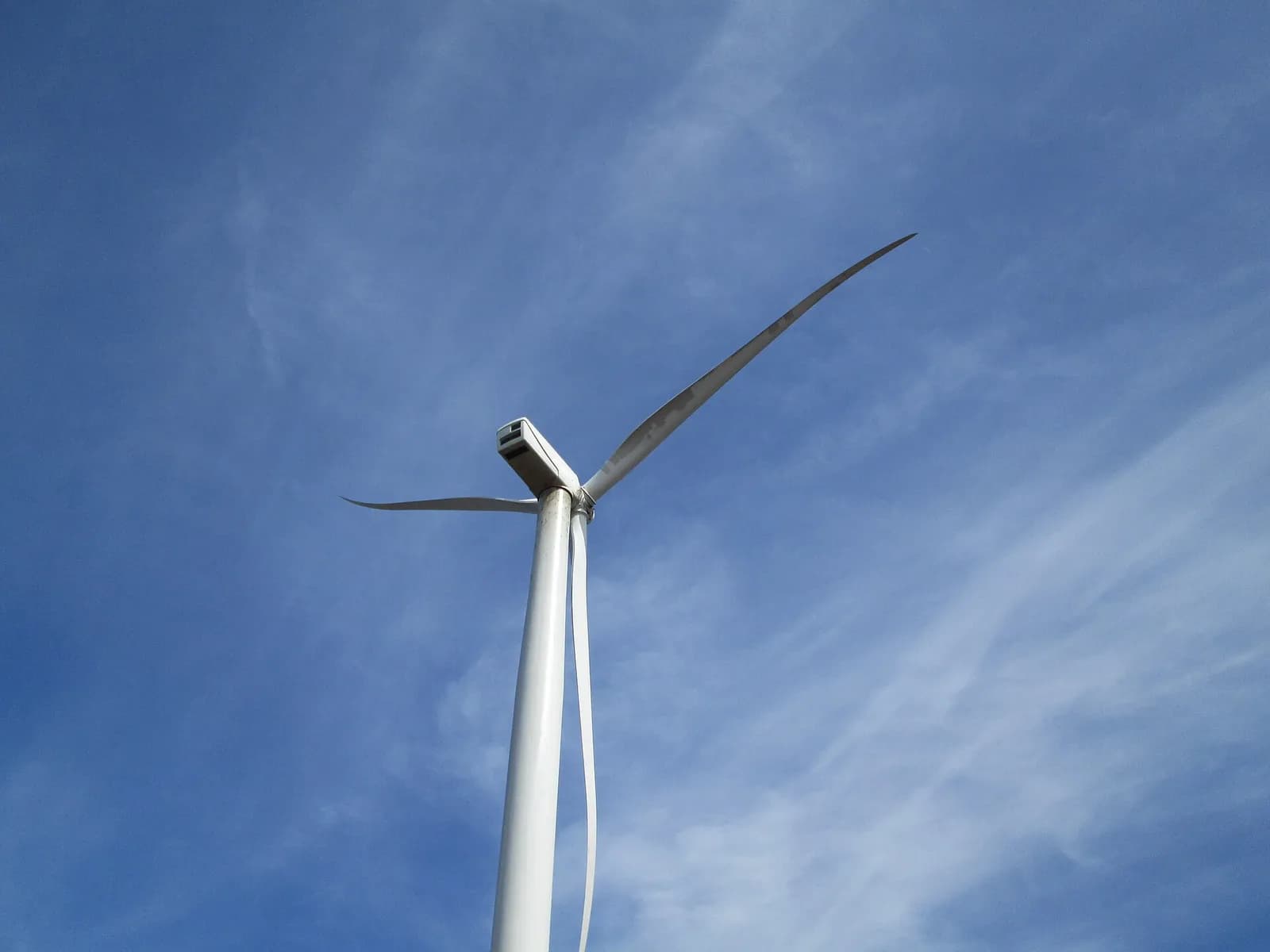
Photo: Larry (Charlottetown), Wind turbine, North Cape, PEI, Wikimedia Commons, CC BY 2.0, resized. Media details
Section A
Where wind comes from
Wind is air in motion, and it is ultimately driven by the Sun. Sunlight heats Earth’s surface unevenly: land, water, forests and ice warm at different rates. Warmer air expands and rises, creating differences in air pressure, and air flows from higher-pressure areas towards lower-pressure areas. Earth’s rotation curves these flows into large atmospheric circulation patterns, while hills, coastlines, water bodies and vegetation shape local winds. [3]
That is why a coastline or an open ridge can be windier than a sheltered valley, and why turbines are placed after careful wind measurement. Follow the Sun’s energy through Earth’s systems →
Section B
How a wind turbine works
Most large modern turbines are horizontal-axis turbines with three blades that face into the wind. Wind flowing across each blade creates lift, the rotor spins, and a generator converts that rotation into electricity. Some turbines connect the rotor to the generator through a shaft and gearbox; direct-drive turbines connect the rotor directly. Designs differ between manufacturers and models. [3]
Explore a wind turbine
Select a component to learn what it does. The diagram highlights it; the same information appears in text below.
Rotor blades
- Function
- Capture energy from the wind.
- Role in generating electricity
- Moving air flowing across the blades creates aerodynamic lift that pushes them around.
- In simple terms
- The blades are shaped like aeroplane wings. Wind moving across them creates a pressure difference that makes them turn.
Technical detail
Air pressure decreases on one side of the blade. The difference across the two sides creates lift and drag; lift is stronger, so the rotor spins. [3]
The energy conversion sequence
- Moving air
- Aerodynamic forces on blades
- Rotor rotation
- Generator
- Electrical energy
- Electrical system
- Kinetic energy
- The energy of motion. Moving air carries kinetic energy.
- Mechanical energy
- The rotating rotor and shaft carry energy as mechanical rotation.
- Electrical energy
- The generator converts rotation into electric current that can travel through cables.
A turbine never converts all of the wind’s kinetic energy into electricity. Air must keep flowing past the rotor, and there are aerodynamic, mechanical and electrical losses at every stage.
Section C
Why turbines produce different amounts of electricity
- Power (kW, MW)
- The rate at which energy is transferred at a given moment.
- Energy (kWh, MWh)
- An amount of energy transferred or produced over time. Power × time = energy.
- Installed, or nameplate, capacity
- The maximum power output a turbine is rated to produce. A 2 MW turbine does not produce 2 MW continuously.
- Capacity factor
- Actual energy generated over a period, divided by what the turbine would generate running at its full rating for that entire period.
Hypothetical example: one 2 MW turbine over a year
Running at full rating for all 8,760 hours of a year, a 2 MW turbine would generate 2 MW × 8,760 h = 17,520 MWh. Real turbines generate less because the wind varies. Adjust the hypothetical capacity factor to see the effect.
At a 35% capacity factor, this turbine would generate about 6,132 MWh in a year, out of a theoretical maximum of 17,520 MWh. Its rated power is still 2 MW.
Illustrative calculation only; it is not a forecast for any real turbine.
Real-world capacity factors vary by site and turbine. The IPCC reports that the global average capacity factor for onshore wind farms rose from 27% in 2010 to 36% in 2020. [21]
Go a little deeper: wind speed and the power curve
The energy available in the wind increases very strongly with wind speed, so small changes in wind speed matter. A turbine’s actual output, however, is limited by its rotor size, generator rating and controls. It produces no electricity in calm conditions, rises with wind speed, levels off at its rated output (where pitch controls limit power), and shuts down in very strong winds for protection. [21][3]
Section D
Wind energy in Prince Edward Island
Verified example
Wind Energy Institute of Canada — Wind R&D Park, North Cape
WEICan documents five DeWind D9.2 turbines, each rated at 2 MW, for 10 MW of combined installed capacity. These are capacity figures, not annual generation. [9]
A research-oriented wind park allows turbine performance, maintenance needs, meteorological conditions and electricity-system integration to be studied under real operating conditions rather than only in models or laboratories.
WEICan is cited here as a public source. This website has no partnership with WEICan. See the full PEI case studies →
Section E
Benefits and limitations
Benefits
- Generates electricity without burning fuel, so operation avoids combustion emissions at the point of generation. Manufacturing, maintenance, materials and local environmental effects still matter across the life cycle.
- Can reduce power-system emissions when it displaces higher-emission generation.
- Uses a renewable resource that is replenished by the Sun’s energy.
- Works at many scales, from single distributed turbines to land-based and offshore wind plants.
Limitations
- Output varies with the weather, so electricity systems need flexibility, transmission and sometimes storage.
- Requires suitable sites, grid connections and community engagement.
- Can affect wildlife, including bird and bat collisions; impacts can often be reduced through siting and selective shutdowns.
- Needs materials, including rare earth elements in some generator magnets, plus blade maintenance and end-of-life management.
Low-carbon, not zero-carbon. A turbine’s emissions are concentrated in manufacturing, transport, construction and disposal rather than operation. The IPCC reports that wind technologies repay their carbon footprint in less than a year, but their life-cycle emissions are not zero. [21]
Knowledge check
Test your understanding of wind energy
Next learning step
Where would you like to go next?
Sources & further reading
- [3] U.S. Department of Energy. How Do Wind Turbines Work? (opens in a new tab) (Page metadata 2013; sections dated 2019–2020).
- [21] Clarke, L., Y.-M. Wei et al. / IPCC Working Group III. Climate Change 2022: Mitigation of Climate Change — Chapter 6: Energy Systems (opens in a new tab) (2022).
- [9] Wind Energy Institute of Canada (WEICan). Wind R&D Park (opens in a new tab) (2024-04-04 (page timestamp)).