REAL PLACES. REAL LEARNING.
A small island. A connected energy story.
Wind research at North Cape, solar and storage in Summerside, and wind expansion at Elmira show different parts of an electricity system in practice. These are published facility descriptions, not live readings. [9] [10] [11]
Wind generation · Research
WEICan Wind Research & Development Park
North Cape, Prince Edward Island
 Documentary photograph
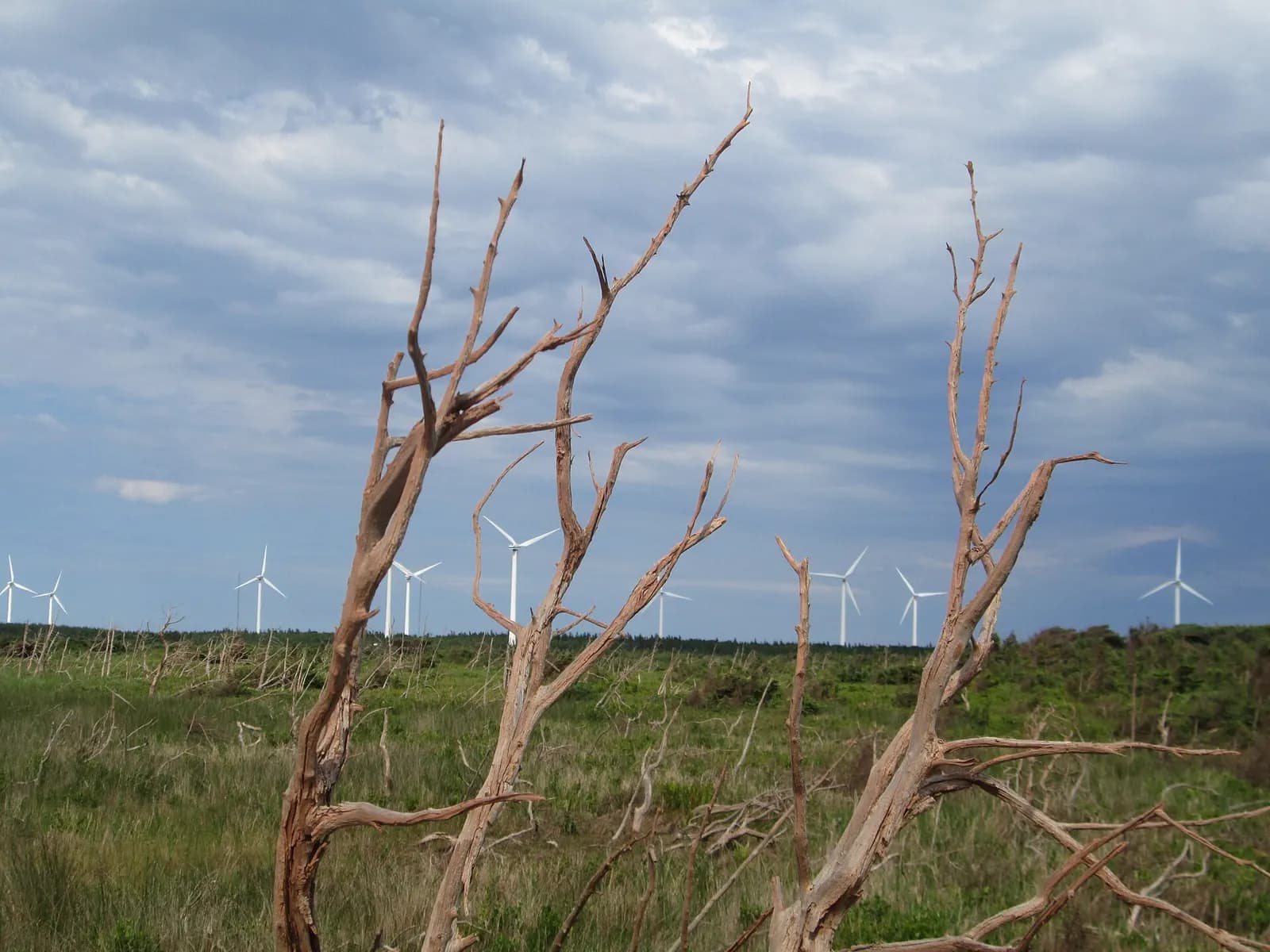
Horizontal-axis turbines face into the wind. Rotor size and steady coastal wind both shape how much energy they can capture.
Photo: Larry (Charlottetown, PEI), CC BY 2.0, resized. Full media credit
.jpg)
Photograph 1 of 2
These photographs show the wind landscape at North Cape. They are not confirmed to show WEICan’s own turbines.
Real project photographs
WEICan publishes its own photographs of the Wind R&D Park, including foundation and tower construction, nacelle and rotor installation, and blade research. They are not openly licensed, so we link to them rather than copy them. Permission has been requested.
View WEICan’s Wind R&D Park photographs (opens in a new tab) ↗10 MW installed wind capacity
Five DeWind D9.2 turbines, each rated at 2 MW. The facility supports wind energy research and development. [9]
What it does
Generate electricity from moving air and study turbine performance in real conditions.
The science in action
Aerodynamic lift turns the blades. Mechanical rotation drives a generator, converting kinetic energy into electrical energy. [3] [1]
Why it matters
An operating research setting helps researchers study turbine performance beyond a laboratory.
What to keep in mind
Wind varies. Maintenance, coastal conditions, wildlife, materials and siting all require attention. [1]
What this project teaches us
Capacity and generation are different measures. Five 2 MW turbines give the park a 10 MW rating; WEICan reports it has generated more than 500 GWh since it began operating in 2012. The park is also a field laboratory, where WEICan tests blade leading-edge protection, turbine lubricants and an ice-free anemometer in real coastal conditions. [24]
What can we learn from this project?
Installed capacity is a power rating—not electricity generated in a year. Annual generation is energy, typically reported in MWh.
Solar generation · Battery storage
Summerside Sunbank Solar and Battery Facility
Summerside, Prince Edward Island
Status update · September 17, 2026
A battery fire occurred at the Sunbank site. In the City and Province’s September 17, 2026 update, the situation was stable, air-quality monitoring showed no evidence of a health risk, drinking water tested safe, and the Fire Department still treated the site as an active fire scene. A longer-term air, water and soil monitoring plan was being developed. The update does not state the facility’s current operating status. [23]
Real project photographs
Be Giant’s September 2, 2026 feature includes documentary photographs of the Sunbank solar arrays by Vanessa Tignanelli. They were published before the battery fire and do not show the site’s current condition. They are copyrighted, so we link to them rather than copy them.
View the Sunbank photographs on Be Giant (opens in a new tab) ↗21.6 MW solar · 10 MW battery power · 20 MWh battery energy
The City’s January 16, 2024 announcement reported that the solar and battery installation had been energized. [10]
What it does
Generate electricity from sunlight and store previously generated energy for later use.
The science in action
Semiconductor photovoltaic cells convert sunlight into electricity. A rechargeable battery stores energy chemically and returns electrical energy on discharge. [5] [1]
Why it matters
Storage can shift available electricity toward times when it is needed, helping manage variation between generation and demand.
What to keep in mind
Sunlight varies; batteries have finite duration, conversion losses and material requirements. Published capacities do not establish actual annual output or emissions savings. Large batteries also need safety design, monitoring and emergency planning. [1]
What this project teaches us
Solar panels generate electricity; batteries store it for later. 21.6 MW, 10 MW and 20 MWh describe different capabilities: in principle, a 10 MW, 20 MWh battery can deliver full power for about two hours, minus conversion losses. Real infrastructure also needs ongoing monitoring, maintenance and safety planning, as the response to the 2026 battery fire shows. [10]
What can we learn from this project?
Solar capacity, battery power and battery energy describe different capabilities. They are not interchangeable rankings.
Wind generation · Infrastructure expansion
Eastern Kings Phase 2 Wind Farm
Elmira, Prince Edward Island
 Documentary photograph
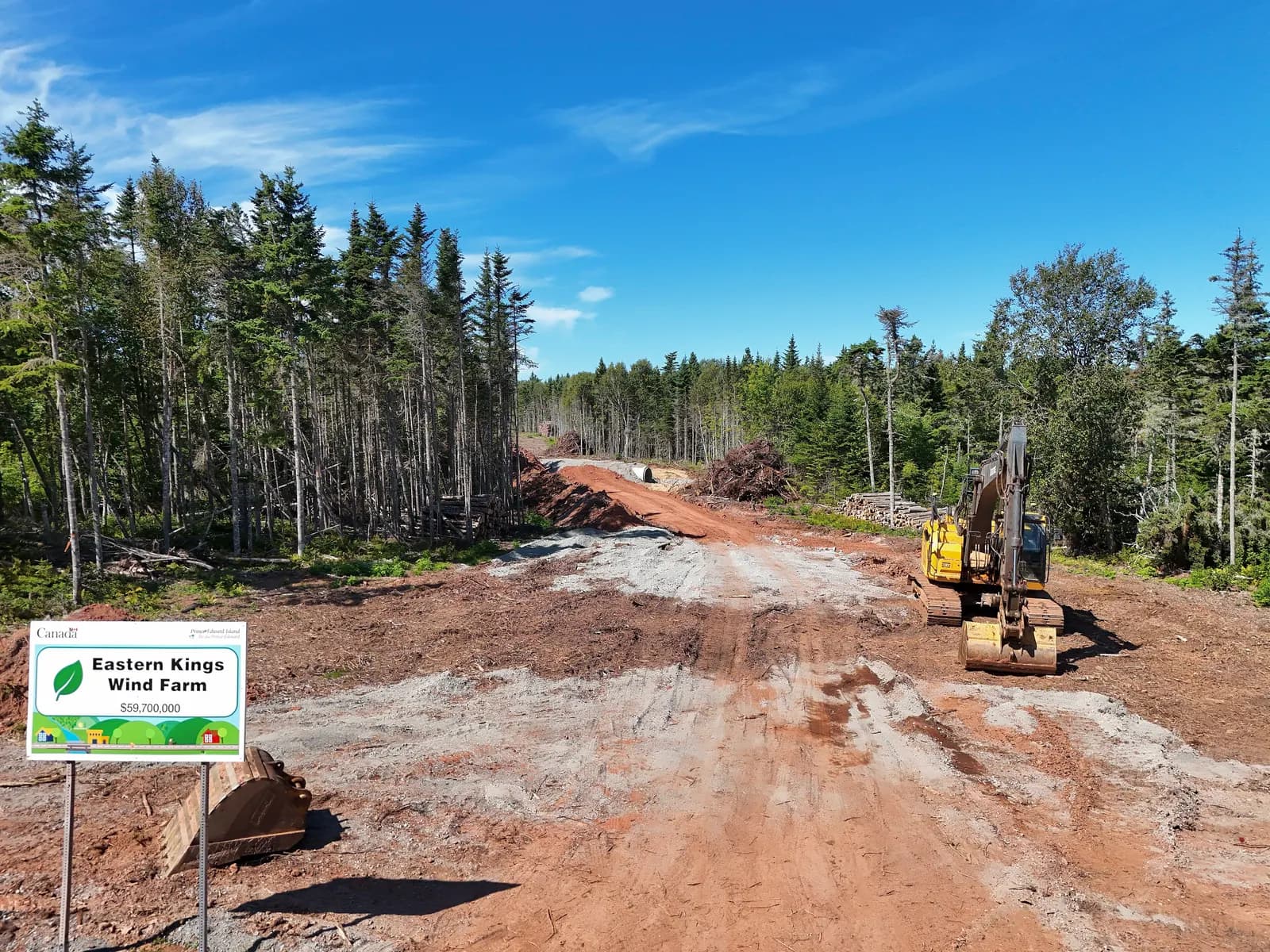
Development stage, September 2024. Before turbines arrive, land is cleared and access roads are built. No turbines are shown.
Photo: Quintin Soloviev, CC BY 4.0, resized. Full media credit

Completed turbines
We have not yet secured an openly licensed or permitted photograph of the completed Phase 2 turbines. The project owner, PEI Energy Corporation, publishes information about the wind farm.
Visit PEI Energy Corporation’s Eastern Kings page (opens in a new tab) ↗29.4 MW Phase 2 · 30 MW original wind farm
The provincial inventory published June 30, 2026 lists Phase 2 with year 2025 and owner PEI Energy Corporation. The original facility is listed separately at 30 MW. [11]
What it does
Add wind generation capacity as electricity infrastructure develops over time.
The science in action
Multiple turbines convert moving-air energy into electricity. Their rated capacities contribute to the installation’s combined power rating. [3] [1]
Why it matters
Adds a renewable generation option within the wider electricity system.
What to keep in mind
Output still varies with wind. Grid connections, other sources, demand and system flexibility must be coordinated; capacity alone does not establish emissions reductions. [1]
What this project teaches us
Wind farms are built in stages: planning and review, site clearing, construction, then operation. The 2024 photograph above shows the clearing stage, not finished turbines. Phase 2 adds 29.4 MW beside the original 30 MW farm, but added capacity describes potential power, not guaranteed output. [11]
What can we learn from this project?
Infrastructure develops in stages. Additional MW describe capability, not a guarantee of constant output.
Follow the energy—not just the numbers.
Sunlight → Solar panels → Electrical system
Electrical system ↔ Battery storage
MW: power
Megawatts describe the rate of energy transfer. Sunbank’s battery has a reported 10 MW power rating.
MWh: energy
Megawatt-hours describe an amount of energy. The battery has a reported 20 MWh storage capacity. [10]
Does that mean two hours of storage?
In an idealized example, 20 MWh delivered at a constant 10 MW would last two hours. Actual usable duration depends on state of charge, losses, operating limits and dispatch. This is a unit illustration, not a measured Sunbank performance claim.
Different technologies. Different roles. One connected energy system.
WEICan Wind Research & Development Park
- Technology
- Wind generation · Research
- Primary purpose
- Generate electricity from moving air and study turbine performance in real conditions.
- Published capacity
- 10 MW installed wind capacity
- Scientific concept
- Aerodynamic lift turns the blades. Mechanical rotation drives a generator, converting kinetic energy into electrical energy.
- Limitation
- Wind varies. Maintenance, coastal conditions, wildlife, materials and siting all require attention.
Wind and solar generate electricity. Batteries store energy; they are not a new energy source. Comparing their capacity numbers as if they ranked the same capability would be misleading.
CLEANTECH FUNDAMENTALS I
From Island projects to course science.
Explore the greenhouse effect, carbon cycle and net zero behind these projects →
Energy conversion and flow
Wind turns a rotor; photovoltaic cells convert sunlight; generators and power electronics connect these processes to electricity use. Energy changes form—it is not created. [3]
Storage and power systems
Storage shifts energy through time. Transmission, diverse sources and demand management also help balance variable supply with demand. [1]
Greenhouse gases and mitigation
Wind and solar can contribute to lower-emissions electricity systems. Avoided emissions depend on the displaced source and the full lifecycle, not installed MW alone. [1]
Materials and environmental trade-offs
Turbines, panels and batteries require materials, manufacturing, land and eventual end-of-life management. Low-emissions does not mean impact-free. [1]
Net-zero pathways
Deep emissions cuts, efficiency and low-emissions electricity work together. No single Island project establishes net zero for the whole energy system. [1]
Take the questions with you.
Ask what a technology does, what its numbers measure, and which source supports the claim. Then consider its place in the wider energy system.
WEICan, the City of Summerside and the Government of PEI are independent cited organizations, not partners or sponsors of this proposed corporation. The existing illustration below is not a photograph of any named facility.
Photo: Larry (Charlottetown), North Cape Wind Farm, Wikimedia Commons, CC BY 2.0. Media details
Where the Island’s electricity comes from
The Canada Energy Regulator reports that PEI is a net importer of electricity, receiving about 69% of its supply from New Brunswick through subsea cables under the Northumberland Strait. Electricity generated on the Island had an emissions intensity of about 2 g CO2e per kWh in 2022, yet transportation (42%), agriculture (24%) and buildings (19%) remained the largest emitting sectors. That is why heating, farming and travel choices matter here, not only power generation.[4]
In shortOn PEI, transportation, agriculture and buildings emit more than electricity generation does.
What an island example can teach us
Research equipment helps reveal how technology performs beyond a laboratory. Wind conditions change, equipment needs maintenance and electricity systems need coordination. WEICan’s stated research and educational mission, described in the case study above, makes it a useful starting point for learning—not evidence that every installation has the same results.[8][3]
In shortA research site shows how technology behaves in real conditions; it does not guarantee results elsewhere.
Buildings and farms: questions worth exploring
Heat pumps and agrivoltaics illustrate questions relevant to homes and agricultural land: how much energy is needed, how land is shared and what local conditions change the outcome. These are educational applications, not claims of specific PEI projects or currently available incentives.[18][6]
In shortEnergy needs, shared land and local conditions decide the outcome.
Separate evidence from ambition
This page distinguishes an existing research facility from possible future applications. Provincial incentive eligibility, project pipelines and policy targets can change. No unverified program details or targets are presented here. Consult current official program documentation before making a financial decision.
In shortCheck current official sources before acting on incentives or targets.
Sources & further reading
- [4] Canada Energy Regulator (CER). Provincial and Territorial Energy Profiles — Prince Edward Island (opens in a new tab) (Date modified March 26, 2026).
- [8] WEICan. Wind Energy Institute of Canada — Research and Development (opens in a new tab) (Not dated).
- [3] U.S. Department of Energy. How Do Wind Turbines Work? (opens in a new tab) (Page metadata 2013; sections dated 2019–2020).
- [18] Natural Resources Canada. Heat Pump Basics (opens in a new tab) (Not dated).
- [6] U.S. Department of Energy. Agrivoltaics: Solar and Agriculture Co-Location (opens in a new tab) (Not dated).